

Does a 2D-vision screw module decide whether an ECU line hits automotive traceability or stays a bench job
2026-08-07
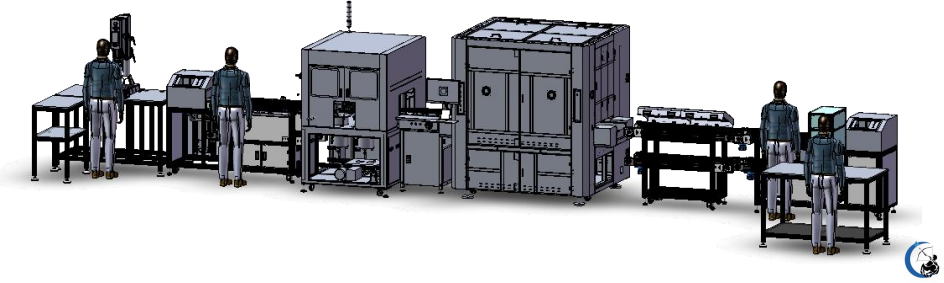
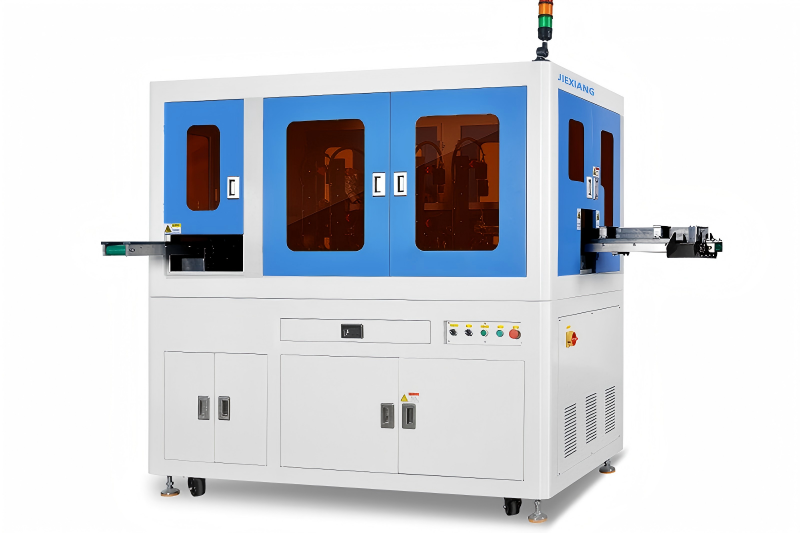
An automotive ECU controller looks calm in the catalog—aluminium housing, one 40-pin connector, four M2.5 screws. On the floor it is the opposite: a bottom shell that needs a 0.3 mm glue bead on a 6 mm-wide flange, a PCBA that must seat within 0.1 mm or the CAN transceiver shield can shorts, a sensor that torques to 0.45 N·m ±0.05, a harness plug a human hand still seats better than any gripper, and a power-on self-test that has to flag a cold solder before the upper cover closes the unit for 10 years of engine-bay heat. Hand-building that at 200 units/hour with three shifts means the screw torque spreadsheet lies by lunchtime. The Automobile controller automatic assembly line — Automobile Controller Automatic Assembly Line Conveying System Automatic Feeding System Electrical Control System Automatic Labeling Machine Robot End Starting Fixture 2D Vision System Screw Vacuum Suction Module Bottom Shell Feeding Glue Dispensing PCBA Wiring Tightening Sensor Tightening Manual Wiring Harness Plugging Power-On Inspection Harness Glue Dispensing Upper Cover Tightening Smart Industrial Automation Solutions 3C New Energy Industrialjx is the belt that removes the lie: bottom shell feed → glue dispense → PCBA place+wire+tighten → sensor tighten → manual harness plug → power-on inspection → harness glue → upper cover tighten, with robot-end fixture + 2D vision for pick-and-place and a screw vacuum suction module + 2D vision for every driven fastener. Built by Industrialjx (same 3C/new-energy/PV automation house that builds the photovoltaic optimizer line), it turns 11 manual benches into one conveyor with a scan at every station. But why does the screw vacuum module need its own 2D camera instead of borrowing the robot vision, how does power-on inspection before upper-cover tightening stop a welded-shut reject, and what makes a conveyor-plus-2D-vision topology the right call for an ECU whose connector pinout revises every two model years? Below is the full breakdown for automotive Tier-1 ECU suppliers, EV controller OEMs, EMS plants, and automation buyers evaluating a line whose real spec is "one shell in, one CAN-pinged unit out, torque logged per screw," not "robots on a video."
Why the ECU line is conveyor + vision + vacuum-screw, not one giant cell
The Automobile controller automatic assembly line — Automobile Controller Automatic Assembly Line Conveying System Automatic Feeding System Electrical Control System Automatic Labeling Machine Robot End Starting Fixture 2D Vision System Screw Vacuum Suction Module Bottom Shell Feeding Glue Dispensing PCBA Wiring Tightening Sensor Tightening Manual Wiring Harness Plugging Power-On Inspection Harness Glue Dispensing Upper Cover Tightening Smart Industrial Automation Solutions 3C New Energy Industrialjx rests on five reconciled facts—glue-bead geometry before PCBA, 2D vision split between pick and screw, power-on gate before cover, manual harness plug as deliberate human-in-loop, and conveyor modularity for ECU revision:
- Bottom-Shell Glue Bead Is 0.3 mm On A 6 mm Flange, So It Dispenses Before PCBA Lands. The ECU bottom shell carries a perimeter flange for IP5K4 sealing; a 0.3 mm triangular glue bead (PUR or silicone) is dispensed on the flange before the automatic feeding system presents the PCBA. If glue came after PCBA placement, the needle would strike SMD capacitors and bridge the DC-DC node. The Industrialjx function list "bottom shell feeding/glue dispensing, PCBA wiring/tightening" is the thermal-and-seal order: shell → glue → PCBA → tighten. The glue cures later in a vertical oven (as on the PV optimizer line), not at the station.
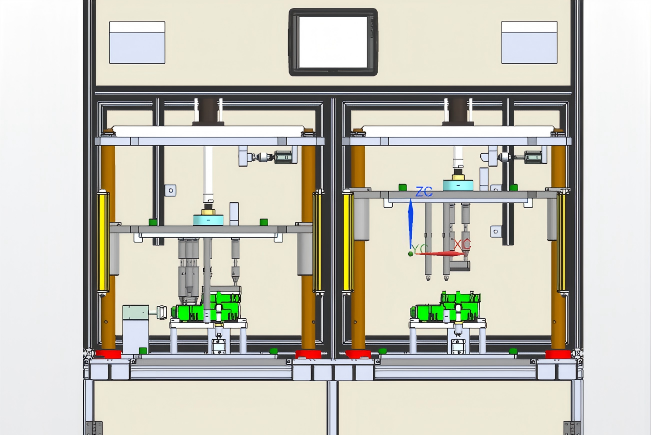
- Robot-End 2D Vision Does Pick-Place; Screw-Vacuum 2D Vision Does Fastener Verify. Two separate 2D cameras, two jobs. The robot-end starting fixture + 2D vision locates the shell pocket and the PCBA fiducials (±0.1 mm placement). The screw vacuum suction module + 2D vision watches the screw from feeder to socket: it confirms the M2.5 is picked (not double-fed), centered in the driver, seated in the threaded hole, and driven to 0.45 N·m with angle monitoring. Borrowing the robot camera for the screw would force the robot to pause every fastener; splitting them lets the conveyor advance while the screw block verifies in parallel. That is why the Industrialjx bill of materials lists both "starting fixture at the end of the robot + 2D vision system" and "screw vacuum suction module + 2D vision system" as separate line items.
- Power-On Inspection Happens Before Upper Cover Tightening—Or The Reject Is Scrapped Welded. After PCBA tightening and sensor tightening, the unit hits a power-on inspection station: 12 V applied, CAN/LIN ping, bootloader handshake, ADC reference check, watchdog test. A cold solder on the CAN transceiver shows up here. If the upper cover were already tightened (or ultrasonically welded, as on the PV optimizer line), the reject would be scrapped with a closed housing—yield loss. Industrialjx puts "power-on inspection" ahead of "upper cover tightening" in the function sequence on purpose; the cover is the last mechanical act, the test is the last electrical gate.
- Manual Wiring Harness Plugging Is A Deliberate Human-In-Loop, Not A Gap. The function list says "manual wiring harness plugging" between sensor tightening and power-on inspection. A 40-pin sealed automotive connector with a secondary lock and a CPA (connector position assurance) clip is still faster and safer with a human thumb than a compliant gripper—grippers either over-force the CPA or miss the latch click. The line designs the station at waist height, presents the harness on a balancer, and the operator has 6 seconds in the takt. Everything else (shell, glue, PCBA, screws, sensors, label, test, cover) is automated; the harness plug stays manual because the cost of a mis-seated connector (intermittent CAN fault in the field) is higher than the cost of one operator per shift. This is the same logic automotive Tier-1s use on BCM lines—not a halfway automation.
- Conveyor + Modular Blocks = ECU Connector Rev Every 2 Model Years. The line is a conveying system with automatic feeding, electrical control, labeling, robot-end vision, and screw-vacuum vision as discrete blocks, not a monolith. When the ECU connector pinout revs (new Ethernet switch IC, different sensor bus), the PCBA fixture, the harness balancer, and the test script swap; the conveyor pitch, the glue block, the labeling block, and the upper-cover screw block stay. A 3C/new-energy EMS running router housings on the night shift reuses the same conveyor and electrical control cabinet—only the middle fixtures change. That is the Industrialjx "smart industrial automation solutions 3C new energy" pitch repeating from the PV line: one belt standard, many SKUs.
Industrialjx / industrialjx.com supply context
From the node (Automobile-controller-automatic-assembly-line) + site header (Smart Industrial Automation Solutions | 3C, New Energy, Photovoltaic) :
- Maker: Industrialjx (industrialjx.com), smart industrial automation solutions for 3C / new energy / automotive / photovoltaic
- Line name: Automobile controller automatic assembly line
- Designed for: Automatic assembly of automobile ECU controllers + post-assembly product testing
- System blocks: Conveying system, automatic feeding system, electrical control system, automatic labeling machine, robot-end starting fixture + 2D vision, screw vacuum suction module + 2D vision
- Function sequence (as published): Bottom shell feeding / glue dispensing → PCBA wiring / tightening → sensor tightening → manual wiring harness plugging → power-on inspection → wiring harness glue dispensing → upper cover tightening
- Scope: Automotive ECU / VCU / BCM / EV controller enclosure assembly (not battery module line, not stringer, not inverter power-stage line)
- URL:
Key characteristics and application scope
- Product Name: Automobile controller automatic assembly line
- Alternate Terms: Industrialjx automotive ECU automatic assembly line conveyor 2D vision screw vacuum bottom shell glue PCBA power-on test upper cover tighten, automobile controller smart assembly cell 3C new energy, EV VCU BCM automatic line robot-end fixture 2D vision screw module, industrialjx.com ECU line
- Line class: Conveyor-connected modular assembly + test cell for automotive electronic control units (not domain-controller liquid-cooled bracket line, not battery pack line)
- Core Applications:
- Automotive ECU / Engine Control Module — aluminium/PP shell, PCBA + shield can, 4–8 M2.5 screws, CAN/LIN power-on
- VCU (Vehicle Control Unit) — EV/HEV, sensor tightening + harness plug + bootloader ping
- BCM (Body Control Module) — 40-pin sealed connector, CPA manual plug, IP5K4 glue bead
- EV controller (low-voltage logic half) — pairs with power-stage line, shares conveyor standard
- Non-use cases: battery-cell stacking (needs press + weld), glass lamination, string inverter power-stage (high-current busbar torque >12 N·m, different screw module)
- Companion logic: Same Industrialjx PO pairs automobile controller line + PV optimizer line + 3C router line; conveyor pitch and electrical cabinet standardized, middle fixtures swap per SKU.
Application logic by buyer type
- Tier-1 ECU Supplier (EU, 600k units/yr): Conveyor takt 18 s, robot-end 2D ±0.1 mm, screw-vacuum 2D verifies every M2.5 (0.45 N·m ±0.05, angle monitored), power-on CAN ping 100%, label QR scanned at entry + at cover tighten, reject gate pre-cover, MES torque log per screw.
- EV Controller OEM (CN, 250k units/yr): Same line, sensor block adds torque strategy for current-sense shunt, harness balancer swapped for 32-pin HV interlock plug, test script adds BMS-comms ping, upper-cover screw block re-fixtured for PA66-GF longer screws.
- EMS Plant (Mexico, mixed automotive+3C): ECU line days, industrial router line nights; screw-vacuum module and robot-end vision stay, PCBA fixture + harness balancer + test PC swap in 5 h.
- Startup VCU Brand (India, 40k/yr pilot): Phase-1 buy conveyor + bottom-shell glue + PCBA place + power-on test + manual harness + upper-cover tighten; add sensor-tighten and screw-vacuum vision in phase-2; conveyor pre-sized for full block set.
Procurement and spec checklist
When specifying Automobile controller automatic assembly line — Automobile Controller Automatic Assembly Line Conveying System Automatic Feeding System Electrical Control System Automatic Labeling Machine Robot End Starting Fixture 2D Vision System Screw Vacuum Suction Module Bottom Shell Feeding Glue Dispensing PCBA Wiring Tightening Sensor Tightening Manual Wiring Harness Plugging Power-On Inspection Harness Glue Dispensing Upper Cover Tightening Smart Industrial Automation Solutions 3C New Energy Industrialjx:
✅ Conveyor — belt or pallet-chain, pitch stated, RFID or QR at each fixture, scan at ≥5 gates.
✅ Vision split — robot-end 2D for pick/place (±0.1 mm), screw-vacuum 2D for fastener verify (pick/center/drive); confirm separate cameras, not shared.
✅ Glue order — bottom-shell flange glue before PCBA placement; bead 0.3 mm / flange 6 mm reference, needle no-strike window specified.
✅ Screw torque — M2.5 class 0.45 N·m ±0.05 with angle monitoring; data exported per screw to MES, not averaged.
✅ Test gate — power-on inspection before upper-cover tightening; CAN/LIN/bootloader/ADC/watchdog in the test script.
✅ Harness station — manual plug deliberate, waist-height, balancer-presented, 6 s takt budget; CPA click verified by operator + camera assist optional.
✅ Label — automatic labeling machine prints/affixes QR; scan at entry and at cover-tighten for trace closure.
✅ Modularity — conveyor pitch, electrical cabinet, glue block, label block, upper-cover screw block stay across ECU revisions; only PCBA fixture / harness balancer / test PC swap.
✅ Throughput — takt 15–20 s; belt speed vs oven dwell math provided.
Conclusion: The ECU line earns its keep at the screw camera and the power-on gate
The Automobile controller automatic assembly line — Automobile Controller Automatic Assembly Line Conveying System Automatic Feeding System Automatic Labeling Machine Robot End Starting Fixture 2D Vision System Screw Vacuum Suction Module Bottom Shell Feeding Glue Dispensing PCBA Wiring Tightening Sensor Tightening Manual Wiring Harness Plugging Power-On Inspection Harness Glue Dispensing Upper Cover Tightening Smart Industrial Automation Solutions 3C New Energy Industrialjx is not a PV optimizer line with bigger screws and it is not a battery line with a conveyor bolted on. It is a conveyor cell where the bottom shell gets a 0.3 mm glue bead before the PCBA lands, the robot-end 2D camera places the board to ±0.1 mm, the screw vacuum module's own 2D camera verifies every M2.5 from feeder to driven seat at 0.45 N·m, the sensor tightens on a second torque plane, a human plugs the 40-pin harness because the CPA still needs a thumb, the unit powers on and pings CAN before the upper cover closes it for 10 years of engine-bay heat, and the label QR scans at entry and at the last screw. Built by Industrialjx on the same 3C/new-energy/PV automation backbone, it swaps its PCBA fixture and test script when the connector revs and keeps the belt, the glue block, the label machine, and the screw-vacuum vision—so the same cell builds an ECU on the day shift and a router housing on the night shift. Its metric is "one shell in, one CAN-pinged unit out, torque logged per screw," not "stations per minute on a brochure."
Recent Posts
Contact US
Product Information
Quantity
Unit
Piece
Support order samples, customization, wholesale direct, and complete payment. If the product you look for does not have corresponding customized content, pls fill out the form below to contact us, and we will reply ASAP.